Menu


Start Free $129 Lifetime
Why is it the #1 bulk uploader?
- Insanely fast!
- Maintains folder structure.
- 100% automated upload.
- Supports RAW files.
- Privacy default.
How can you get started?
Download PicBackMan and start free, then upgrade to annual or lifetime plan as per your needs. Join 100,000+ users who trust PicBackMan for keeping their precious memories safe in multiple online accounts.
Trusted by users in 125+ countries.
“Your pictures are scattered. PicBackMan helps you bring order to your digital memories.”

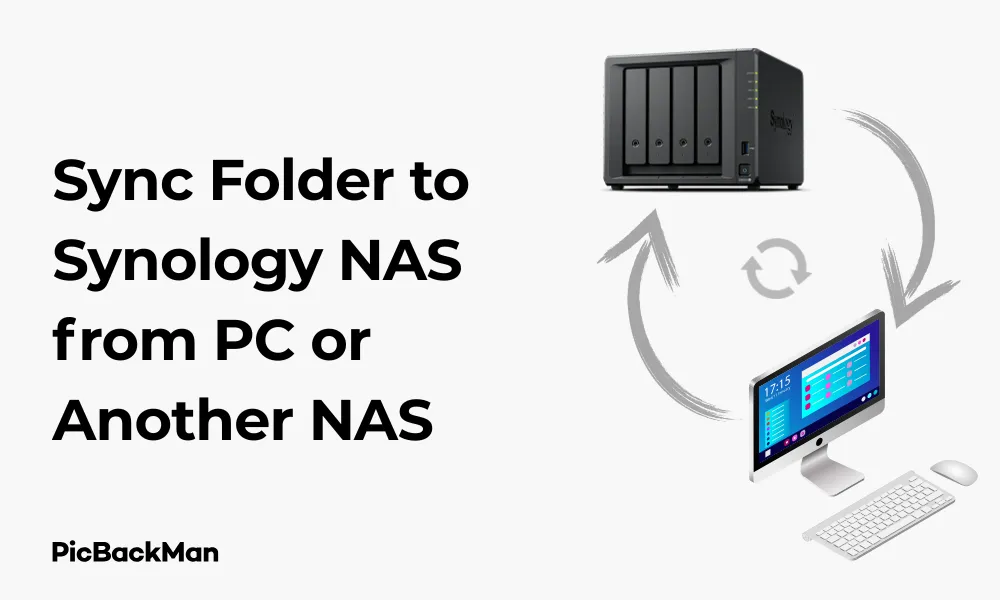
Sync Folder to Synology NAS from PC or Another NAS

Keeping your files synchronized between your computer and a Synology NAS can save you time and ensure you always have access to the most current versions of your documents. Whether you're backing up important files or sharing data across multiple devices, setting up folder synchronization with your Synology NAS is a practical solution. In this guide, I'll walk you through different methods to sync folders to your Synology NAS from your PC or another NAS device.
What You'll Need Before Starting
- A Synology NAS device with DSM (DiskStation Manager) installed
- Network access to your Synology NAS
- Admin credentials for your Synology NAS
- The PC or other NAS you want to sync from
- Stable network connection
Method 1: Using Synology Drive to Sync Folders
Synology Drive is the official solution for file synchronization between your computer and Synology NAS. It works similarly to cloud storage services but keeps your data on your personal NAS.
Setting Up Synology Drive on Your NAS
- Log into your Synology DSM using your admin credentials
- Open Package Center from the main menu
- Search for "Synology Drive" and click "Install"
- Once installed, open Synology Drive from the main menu
- Follow the setup wizard to configure basic settings
Installing Synology Drive Client on Your PC
- On your Synology DSM, go to the main menu and open Synology Drive
- Click on the "Download" button in the top-right corner
- Select "Download Synology Drive Client" for your operating system (Windows/Mac/Linux)
- Run the installer on your PC and follow the installation steps
- Launch Synology Drive Client after installation
Setting Up Folder Sync
- In Synology Drive Client, click "Sign in"
- Enter your NAS server address (e.g., diskstation:5000 or the IP address)
- Enter your Synology account credentials and click "Sign in"
- Click on "Tasks" and then "Create task"
- Select "Sync task" from the options
- Choose "Bidirectional sync" if you want changes to sync both ways, or "Upload only" if you only want to send files to the NAS
- Click "Next"
- Select the local folder on your PC that you want to sync
- Select the destination folder on your Synology NAS
- Click "Next" and then "Done" to start the sync task
Your files will now begin syncing between your PC and Synology NAS. The initial sync may take some time depending on the amount of data.
Method 2: Using Shared Folders and Windows File Explorer
If you prefer a more direct approach without installing additional software, you can use Windows built-in tools to sync folders.
Creating a Shared Folder on Synology NAS
- Log into your Synology DSM
- Go to "Control Panel" > "Shared Folder"
- Click "Create" > "Create Shared Folder"
- Enter a name and description for your shared folder
- Configure permissions as needed
- Click "OK" to create the shared folder
Mapping the Network Drive on Windows
- Open File Explorer on your Windows PC
- Right-click on "This PC" or "Computer"
- Select "Map network drive"
- Choose a drive letter from the dropdown menu
- In the "Folder" field, enter the path to your Synology shared folder (e.g., \diskstationsharename or \IP-addresssharename)
- Check "Reconnect at sign-in" if you want this connection to be permanent
- Click "Finish"
- Enter your Synology credentials if prompted
Setting Up Folder Sync with Windows Tools
- Open Command Prompt as administrator
- Use the Robocopy command to sync your folders:
robocopy "C:YourLocalFolder" "Z:YourNASFolder" /MIR /Z /FFT /R:3 /W:10 /TEE /LOG:sync_log.txt - To automate this process, create a batch file with this command and schedule it using Task Scheduler
Understanding Robocopy Parameters:
- /MIR - Mirrors the directory tree
- /Z - Restartable mode for better reliability
- /FFT - Assumes FAT file times (2-second precision)
- /R:3 - Number of retries on failed copies
- /W:10 - Wait time between retries in seconds
- /TEE - Display output in console window and log file
- /LOG - Creates a log file
Method 3: Using Synology's Cloud Station ShareSync for NAS to NAS Sync
If you need to sync folders between two Synology NAS devices, Cloud Station ShareSync is a great option.
Setting Up ShareSync on Both NAS Devices
- On both Synology NAS devices, open Package Center
- Search for "Cloud Station ShareSync" and install it
- Open Cloud Station ShareSync on both NAS devices
Configuring the Source NAS
- On the source NAS, open Cloud Station ShareSync
- Go to "Settings" and ensure the service is running
- Note down the server address (typically your NAS hostname or IP address)
- Create a dedicated user account for syncing if you haven't already (for better security)
Configuring the Destination NAS
- On the destination NAS, open Cloud Station ShareSync
- Click "Add Sync Task"
- Enter the server address of your source NAS
- Enter the username and password for the source NAS
- Select the shared folder from the source NAS that you want to sync
- Select the destination folder on the current NAS
- Choose sync direction (typically "Download" to sync from source to destination)
- Click "Apply" to start the sync task
Method 4: Using Synology Hyper Backup for One-Way Backup
If your primary goal is backup rather than synchronization, Hyper Backup offers more features for data protection.
Setting Up Hyper Backup
- On your Synology NAS, open Package Center
- Search for "Hyper Backup" and install it
- Open Hyper Backup from the main menu
- Click the "+" button to create a new backup task
Backing Up to Another Synology NAS
- Select "Synology NAS device" as your backup destination
- Enter the server address, port, username, and password for the destination NAS
- Select or create a shared folder on the destination NAS
- Click "Next"
- Select the folders from your source NAS that you want to back up
- Configure backup schedule and rotation settings
- Enable backup encryption if needed
- Click "Apply" to create and start the backup task
Backing Up from PC to Synology NAS Using Hyper Backup Explorer
- Download and install Hyper Backup Explorer on your PC from the Synology website
- Launch Hyper Backup Explorer
- Click "Create" to set up a new backup task
- Select the folders on your PC that you want to back up
- Enter your Synology NAS information (address, username, password)
- Select the destination folder on your NAS
- Configure backup settings and schedule
- Click "Start" to begin the backup process
Method 5: Using rsync for Advanced Users
For those comfortable with command-line tools, rsync offers powerful synchronization capabilities, especially useful for Linux users or advanced Windows users with WSL (Windows Subsystem for Linux).
Enabling rsync on Synology NAS
- Log into your Synology DSM
- Go to "Control Panel" > "File Services"
- Navigate to the "rsync" tab
- Check "Enable rsync service"
- Set a custom port if needed (default is 873)
- Click "Apply"
Using rsync from Linux or macOS
- Open Terminal on your Linux or macOS system
- Use the following command to sync a folder to your NAS:
rsync -avz --progress /path/to/local/folder username@nas-address:/volume1/shared_folder - Enter your password when prompted
Creating an Automated rsync Script
- Create a new file called sync.sh with the following content:
#!/bin/bash

rsync -avz --progress --delete /path/to/local/folder username@nas-address:/volume1/shared_folder - Make the script executable:
chmod +x sync.sh - Add it to crontab to run automatically:
crontab -eAdd a line like this to run it daily at 2 AM:
0 2 * * * /path/to/sync.sh
Method 6: Using FreeFileSync for Custom Synchronization
FreeFileSync is a powerful third-party tool that offers flexible synchronization options between your PC and NAS.
Setting Up FreeFileSync
- Download and install FreeFileSync from the official website
- Launch FreeFileSync
- Click on "Browse" on the left panel and select your source folder on your PC
- Click on "Browse" on the right panel and navigate to your mapped Synology NAS drive
- Choose your synchronization settings:
- "Two way" for bidirectional sync
- "Mirror" to make the target identical to the source
- "Update" to only copy newer files to the target
- Click "Compare" to see what will be synchronized
- Click "Synchronize" to start the process
Creating an Automated Batch Job
- After setting up your sync configuration, click on "Save As Batch Job"
- Give your batch job a name and save it
- To automate this, click on "Save As Batch Job" again, but select "Create scheduled task"
- Configure the schedule according to your needs
- Click "OK" to create the scheduled task
Comparison of Sync Methods
| Method | Ease of Use | Features | Best For | Limitations |
|---|---|---|---|---|
| Synology Drive | Easy | Real-time sync, version history, cross-platform | Regular users needing constant sync | Requires client software installation |
| Windows File Explorer | Medium | No extra software needed, manual control | Simple, occasional file transfers | No automatic sync, limited features |
| Cloud Station ShareSync | Medium | NAS-to-NAS sync, selective sync | Syncing between multiple Synology devices | Only works with Synology NAS devices |
| Hyper Backup | Medium | Versioning, encryption, multiple backup targets | Data backup rather than synchronization | One-way backup only, not real-time |
| rsync | Hard | Powerful, scriptable, bandwidth-efficient | Advanced users, server environments | Command line only, steep learning curve |
| FreeFileSync | Medium | Flexible rules, visual comparison, cross-platform | Users needing customized sync rules | Third-party software, manual setup |
Troubleshooting Common Sync Issues
Connection Problems
- Verify that your NAS is powered on and connected to the network
- Check if you can access the NAS through its web interface
- Try pinging your NAS from your PC to confirm network connectivity
- Make sure your firewall isn't blocking the connection
- Verify that the required ports are open (5000/5001 for DSM, 6690 for Synology Drive)
Sync Failing or Slow
- Check your internet or local network speed
- Verify that you have enough free space on both the source and destination
- Try syncing smaller batches of files
- Restart the sync service or application
- Check log files for specific error messages
Permission Issues
- Verify that your user account has the necessary permissions on both systems
- Check shared folder permissions on the Synology NAS
- Try using an administrator account to rule out permission problems
- Check if any files are locked or in use during sync
File Conflicts
- Set clear sync rules for handling conflicts (newer file wins, manual resolution, etc.)
- Check conflict logs in your sync application
- Avoid editing the same files simultaneously on different devices
- Consider using version control for frequently edited files
Best Practices for Syncing to Synology NAS
Security Considerations
- Always use strong passwords for your Synology account
- Enable two-factor authentication when possible
- Consider creating dedicated user accounts for sync tasks
- Use encrypted connections (HTTPS/SSL) when syncing over the internet
- Keep your Synology DSM and sync applications updated
Performance Optimization
- Schedule large syncs during off-peak hours
- Use wired connections instead of Wi-Fi for large data transfers
- Exclude unnecessary files and folders from sync (like temporary files or caches)
- Consider using compression for syncing over slow connections
- Split very large sync tasks into smaller, manageable chunks
Data Organization
- Plan your folder structure before setting up sync
- Use consistent naming conventions
- Keep sync paths as short as possible
- Separate data by type or project for easier management
- Document your sync setup for future reference
Quick Tip to ensure your videos never go missing
Videos are precious memories and all of us never want to lose them to hard disk crashes or missing drives. PicBackMan is the easiest and simplest way to keep your videos safely backed up in one or more online accounts.
Simply download PicBackMan (it's free!), register your account, connect to your online store and tell PicBackMan where your videos are - PicBackMan does the rest, automatically. It bulk uploads all videos and keeps looking for new ones and uploads those too. You don't have to ever touch it.
Conclusion
Setting up folder synchronization between your PC or another NAS and your Synology NAS doesn't have to be complicated. Whether you prefer the simplicity of Synology Drive, the power of rsync, or something in between, there's a method that fits your needs.
For most users, Synology Drive offers the best balance of features and ease of use. It provides real-time synchronization and works across different platforms. For NAS-to-NAS synchronization, Cloud Station ShareSync or Hyper Backup are excellent choices depending on whether you need two-way sync or backup.
Remember to consider your specific requirements, such as sync frequency, direction, and security needs, when choosing a method. With the right setup, you'll have seamless access to your files across all your devices while keeping everything safely backed up on your Synology NAS.
Frequently Asked Questions
Can I sync multiple folders to my Synology NAS simultaneously?
Yes, you can set up multiple sync tasks with Synology Drive or other methods. Each task can have its own source folder, destination folder, and sync settings. This allows you to maintain different sync schedules and rules for different types of data.
Will syncing delete files from my computer?
It depends on the sync method and settings you choose. Two-way or bidirectional sync will reflect deletions on both sides. If you use "mirror" settings, the destination will match the source, potentially deleting files. If you're concerned about accidental deletions, choose "upload only" or "update" options, which only add files to the destination without removing anything.
How often does Synology Drive sync my files?
Synology Drive can sync files in near real-time. When you make changes to a file in a synced folder, Drive Client detects the change and begins uploading it to your NAS almost immediately. You can also manually adjust sync schedules for certain tasks if you prefer less frequent syncing.
Can I access my synced files when I'm away from home?
Yes, if you've set up remote access to your Synology NAS. This typically involves configuring QuickConnect or setting up a DDNS service and port forwarding on your router. Once remote access is established, you can use Synology Drive mobile apps or web interface to access your files from anywhere with an internet connection.
Is there a size limit for files I can sync to my Synology NAS?
The maximum file size depends on the file system used on your Synology NAS. With the default Btrfs or ext4 file systems, individual files can be up to 16TB in size (though practical limits may be lower). However, very large files may take a long time to sync and could be affected by network interruptions. For extremely large files, consider using a direct file transfer method rather than continuous sync.