Menu


Start Free $129 Lifetime
Why is it the #1 bulk uploader?
- Insanely fast!
- Maintains folder structure.
- 100% automated upload.
- Supports RAW files.
- Privacy default.
How can you get started?
Download PicBackMan and start free, then upgrade to annual or lifetime plan as per your needs. Join 100,000+ users who trust PicBackMan for keeping their precious memories safe in multiple online accounts.
Trusted by users in 125+ countries.
“Your pictures are scattered. PicBackMan helps you bring order to your digital memories.”

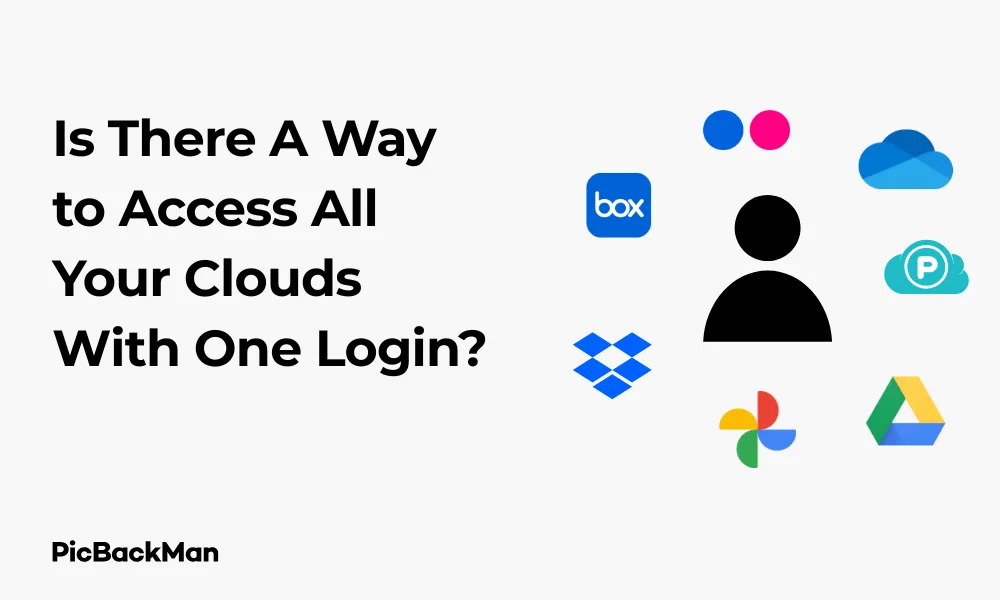
Is There A Way to Access All Your Clouds With One Login?

Managing multiple cloud storage accounts can be a real headache. If you're tired of remembering dozens of passwords and jumping between different cloud platforms, you're not alone. The good news is that you can access all your clouds with one login, making your digital life much simpler.
In this guide, I'll show you exactly how to unify your cloud access, save time, and boost your productivity by creating a single entry point to all your cloud storage services.
Why You Might Need a Single Login for Multiple Cloud Services
Before diving into the solutions, let's consider why having one login for all your cloud services makes sense:
- You use multiple cloud storage providers (Google Drive, Dropbox, OneDrive, etc.)
- You're constantly logging in and out of different cloud accounts
- You struggle to remember which files are stored where
- You need to transfer files between different cloud services frequently
- You want to search across all your cloud storage from one interface
- You're concerned about security but tired of managing multiple passwords
If any of these situations sound familiar, a unified cloud access solution might be exactly what you need.
The Best Ways to Access Multiple Cloud Services with One Login
Let's explore the most effective methods to access all your cloud storage accounts with a single login:
1. Cloud Management Platforms
Cloud management platforms are specialized tools designed to connect multiple cloud services under one interface. They're the most direct solution to the multi-cloud problem.
Top Cloud Management Platforms
| Platform | Free Option | Supported Cloud Services | Best For |
|---|---|---|---|
| MultCloud | Yes (limited) | 30+ services including Google Drive, Dropbox, OneDrive, Box | File transfers between clouds |
| odrive | Yes (basic features) | 20+ services including major cloud providers | Unified desktop access |
| Otixo | No (paid plans only) | 35+ cloud services | Business users |
| Cloudsfer | No | 20+ cloud services | Large-scale migrations |
| Boxafe | Yes (limited storage) | Major cloud providers | Security-focused users |
How to Set Up MultCloud (Example Process)
Let's walk through setting up MultCloud as an example of how cloud management platforms work:
- Visit the MultCloud website and create a free account
- Click "Add Cloud" from the dashboard
- Select your first cloud service (eg, Google Drive)
- Grant MultCloud permission to access your account
- Repeat the process for each cloud service you want to include
- Once connected, you can access all services from the MultCloud dashboard
After setup, you'll have a single dashboard to view, manage, and transfer files across all your cloud storage accounts without needing to log in to each service separately.
2. Password Managers with Auto-Login Features
If you prefer keeping your original cloud interfaces but want to simplify logins, password managers offer an excellent alternative:
How Password Managers Help with Cloud Access
- Store all your cloud service passwords securely
- Auto-fill login credentials when you visit cloud storage sites
- Generate and manage strong, unique passwords for each service
- Sync across all your devices
- Some offer secure file storage themselves
Top Password Managers for Cloud Access
| Password Manager | Free Option | Auto-Fill Capability | Additional Features |
|---|---|---|---|
| LastPass | Yes (limited) | Excellent | Secure notes, form filling |
| 1Password | No | Excellent | Travel mode, watchtower |
| Bitwarden | Yes (generous free plan) | Very good | Open source, self-hosting option |
| Dashlane | Yes (limited) | Excellent | VPN included in premium plans |
| KeePass | Yes (completely free) | Good (with plugins) | Offline option, highly customizable |
Setting Up Bitwarden for Cloud Access (Example)
- Create a Bitwarden account and install the browser extension
- Add login credentials for each cloud service to your vault
- When visiting a cloud service website, Bitwarden will offer to auto-fill credentials
- Use the Bitwarden mobile app to access your clouds on mobile devices
While this approach still requires you to visit each cloud service's website separately, it eliminates the need to remember or type passwords, creating a smoother experience.
3. Single Sign-On (SSO) Solutions
For businesses and organizations, Single Sign-On (SSO) solutions provide a more integrated approach:
How SSO Works for Cloud Access
SSO allows users to log in once and access multiple applications without re-entering credentials. Here's how it works:
- You authenticate once with the SSO provider
- The SSO service creates a token that verifies your identity
- When you access connected cloud services, the token is used instead of requiring a new login
- You can access all connected services without additional logins until your session expires
Popular SSO Providers
| SSO Provider | Best For | Cloud Service Integration |
|---|---|---|
| Okta | Enterprises | 7,000+ pre-built integrations |
| OneLogin | Mid-sized businesses | 6,000+ pre-integrated apps |
| Azure Active Directory | Microsoft-focused organizations | Strong Microsoft ecosystem integration |
| JumpCloud | Small to medium businesses | Good cloud directory service |
| Auth0 | Developers and custom solutions | Flexible identity platform |
SSO solutions typically require IT setup and are more suitable for business environments than individual users.
4. Desktop Applications with Multi-Cloud Support
Desktop applications can provide a seamless experience for accessing multiple clouds from your computer:
Popular Multi-Cloud Desktop Applications
- Rclone : A command-line program to manage files on cloud storage (for technical users)
- Mountain Duck : Mounts cloud storage as local disks on your computer
- CloudMounter : Mount cloud storage as local drives on Mac and Windows
- ExpanDrive : Access cloud storage like a local drive
- Cyberduck : Open-source client for FTP and cloud storage
Setting Up CloudMounter (Example)
- Download and install CloudMounter
- Launch the application and create an account
- Click the "+" button to add a new cloud connection
- Select your cloud service provider
- Enter your credentials and connect
- Repeat for each cloud service
- Once connected, access all your clouds as if they were local drives
The advantage of desktop applications is that they integrate directly with your file system, allowing you to work with cloud files just like local files.
5. Web-Based File Managers
Web-based file managers provide browser access to multiple cloud services:
Popular Web-Based File Managers
- FileBrowser : Self-hosted file manager that can connect to multiple storage sources
- AnyClient : Web-based file manager for cloud services
- pCloud : Offers a unified interface with its Transfer feature
- Koofr : Connect multiple cloud accounts and manage them together
These solutions are particularly useful if you need to access your files from different computers without installing software.
How to Choose the Right Solution for Your Needs
With so many options available, how do you choose the right one? Consider these factors:
For personal use
If you're an individual user, ask yourself:
- How many cloud services do you use? If it's just 2-3, a simpler solution might suffice
- Do you need to transfer files between services? Choose a solution with good transfer capabilities
- Are you tech-savvy? Some solutions require more technical knowledge than others
- Budget constraints? Many solutions offer free tiers with limitations
- Mobile access important? Check if the solution offers mobile apps
For Business Use
For organizations, consider:
- Security requirements : Look for solutions with strong encryption and compliance features
- User management : How easily can you add/remove users?
- Integration with existing systems : Will it work with your current IT infrastructure?
- Scalability : Can the solution grow with your organization?
- Support quality : Business solutions should offer reliable support
Step-by-Step Guide to Unifying Your Cloud Access
Ready to set up a unified cloud access system? Follow these steps:
Step 1: Inventory Your Cloud Services
Make a list of all cloud services you currently use, including:
- Storage services (Google Drive, Dropbox, OneDrive, etc.)
- Email services that include storage (Gmail, Outlook)
- Specialized storage (photo storage, document storage)
- Business applications with file storage components
Step 2: Determine Your Requirements
Ask yourself what you need from a unified solution:
- Simple login only, or full file management?
- Do you need to search across all clouds?
- Is file transfer between services important?
- Do you need mobile access?
- What's your budget?
Step 3: Choose Your Solution
Based on your requirements, select one of the approaches discussed earlier:
- Cloud management platform
- Password manager
- SSO solution
- Desktop application
- Web-based file manager
Step 4: Set Up Your Chosen Solution
Follow the setup instructions for your chosen solution. Generally, this involves:
- Creating an account with the service provider
- Connecting each of your cloud services
- Authorizing access to each service
- Configuring any specific settings or preferences
Step 5: Organize Your Files (Optional)
Once your unified solution is set up, consider organizing your files:
- Create a consistent folder structure across clouds
- Consider which types of files belong on which services
- Remove duplicate files
- Use tags or labels if your solution supports them
Step 6: Set Up Backup Procedures
Having all your clouds accessible from one place doesn't replace good backup practices:
- Use your unified solution to create backups between cloud services
- Consider additional backup solutions for critical files
- Test your ability to restore files
Security Considerations When Unifying Cloud Access
While convenient, unified cloud access raises some security considerations:
Potential Security Risks
- Single point of failure : If your master account is compromised, all your clouds are at risk
- Third-party access : Most solutions require you to grant access to your accounts
- Data privacy : Consider where and how your access credentials are stored
- Authorization scope : Some services may request more access than necessary
Security Best Practices
To mitigate these risks:
- Use a strong, unique password for your unified access solution
- Enable two-factor authentication (2FA) wherever possible
- Regularly review connected applications and revoke unnecessary access
- Choose solutions that use OAuth rather than storing your passwords
- Read privacy policies carefully before granting access
- Consider the reputation and longevity of the service provider
Comparing Popular Multi-Cloud Access Solutions
Let's compare some of the most popular solutions for accessing multiple clouds with one login:
| Solution | Type | Free Option | File Transfer | File Editing | Mobile Support | Unique Strength |
|---|---|---|---|---|---|---|
| MultCloud | Cloud Manager | Yes | Excellent | No | Limited | Scheduled transfers |
| odrive | Desktop App | Yes | Good | Yes | Yes | Sync any folder |
| Bitwarden | Password Manager | Yes | No | No | Yes | Open-source security |
| CloudMounter | Desktop App | No | Basic | Yes | No | Native file system integration |
| Koofr | Web-based | Yes | Good | Basic | Yes | Duplicate file finder |
| Okta | SSO | No | No | No | Yes | Enterprise-grade security |
Tips for Managing Multiple Cloud Services Effectively
Once you've set up unified access, these tips will help you manage your clouds more effectively:
Organization Strategies
- Assign specific purposes to each cloud service (eg, Google Drive for documents, Dropbox for photos)
- Use consistent naming conventions across all services
- Create a master document that maps where important files are stored
- Consider using one service as your "primary" and others for specific purposes or backups
Automation Possibilities
Many unified solutions offer automation features:
- Set up automatic file transfers between clouds
- Create backup routines that copy important files to secondary services
- Use rules to organize incoming files automatically
- Schedule regular synchronization between services
Handling Duplicate Files
Duplicate files across cloud services can cause confusion:
- Use duplicate file finders included in some unified cloud solutions
- Establish a "file of record" policy for important documents
- Consider version control strategies for frequently updated files
- Delete duplicates after confirming you have the latest version
Quick Tip to ensure your videos never go missing
Videos are precious memories and all of us never want to lose them to hard disk crashes or missing drives. PicBackMan is the easiest and simplest way to keep your videos safely backed up in one or more online accounts.
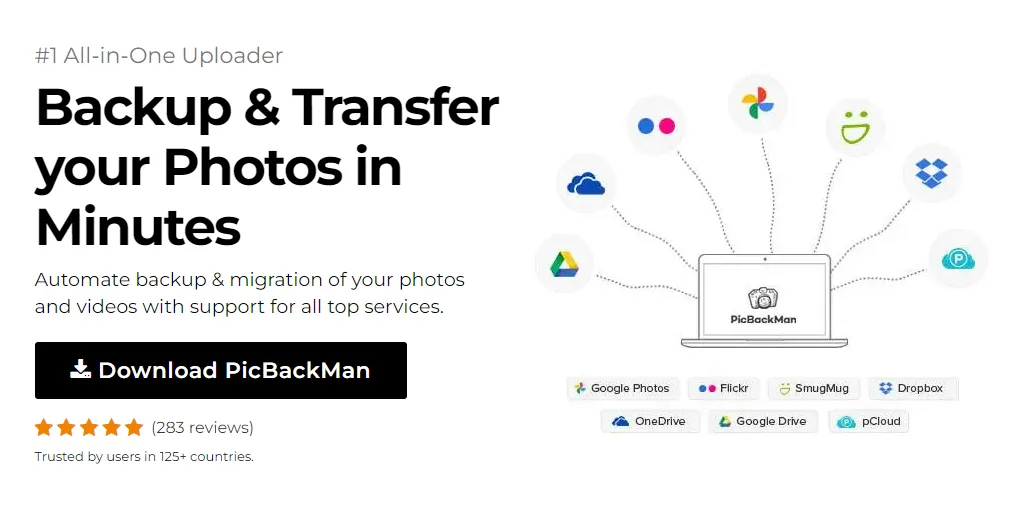
Simply download PicBackMan (it's free!) , register your account, connect to your online store and tell PicBackMan where your videos are - PicBackMan does the rest, automatically. It bulk uploads all videos and keeps looking for new ones and uploads those too. You don't have to ever touch it.
Limitations of Unified Cloud Access
While unified access solutions offer many benefits, they do have some limitations:
What Unified Access Can't Do
- May not support all features of native cloud apps
- Some specialized functions may require logging into the original service
- Performance might be slower than direct access
- Not all file types may be supported for preview or editing
- Some services may limit API access, restricting what unified solutions can do
When Native Apps Might Be Better
Consider sticking with native apps when:
- You need advanced features specific to one cloud service
- You primarily use just one cloud service
- You require maximum performance
- You're working with specialized file types
- Security policies restrict third-party access
Future of Unified Cloud Access
The field of unified cloud access continues to evolve:
Emerging Trends
- AI-powered file organization across multiple clouds
- Improved security models for cross-cloud access
- Better integration with productivity tools
- More sophisticated synchronization options
- Blockchain-based solutions for secure multi-cloud access
What to Watch For
Keep an eye on these developments:
- Cloud service providers creating their own multi-cloud tools
- Industry standards for cloud interoperability
- New authentication methods that improve security while maintaining convenience
- Integration of cloud access with smart home and IoT devices
Conclusion
Accessing all your clouds with one login isn't just possible—it's becoming essential for anyone juggling multiple cloud services. Whether you choose a dedicated cloud management platform, a password manager, or another approach depends on your specific needs.
The solutions we've explored offer varying levels of integration, from simple login assistance to complete file management across services. By choosing the right option for your situation, you can save time, reduce frustration, and make better use of all your cloud storage.
Remember that security remains important—the convenience of unified access should never come at the cost of keeping your data safe. With the right approach, you can enjoy the best of both worlds: the security and specialized features of individual cloud services with the convenience of unified access.
As cloud services continue to multiply, tools that help us manage them effectively will become even more valuable. The future of cloud storage isn't about choosing a single provider—it's about seamlessly integrating multiple services to meet our diverse needs.
Frequently Asked Questions
Is it safe to use a service that accesses all my cloud accounts?
Yes, it can be safe if you choose reputable services that use OAuth authentication rather than storing your actual passwords. Look for services with strong security track records, clear privacy policies, and encryption for your credentials. Always enable two-factor authentication for both your cloud services and the unified access solution.
Will I lose any features when accessing clouds through a unified platform?
Possibly. While unified platforms provide convenience, they may not support every feature of the native cloud applications. Advanced or specialized features might still require logging into the original service. Check whether the features you regularly use are supported before committing to a solution.
Can I access my work cloud accounts along with personal accounts?
This depends on your organization's security policies. Many businesses restrict how corporate cloud accounts can be accessed. Check with your IT department before connecting work accounts to third-party services. Some organizations may have approved solutions for this purpose or might completely prohibit it due to security concerns.
What happens if the unified access service shuts down?
If your unified access service shuts down, you won't lose your files since they remain stored on the original cloud services. You'll just lose the convenient single access point and need to log into each cloud service individually again. To minimize disruption, keep a record of all your cloud services and ensure you know how to access each one directly.
Do unified cloud access solutions work with all cloud storage providers?
No, not universally. Most solutions support major providers like Google Drive, Dropbox, OneDrive, and Box, but support for smaller or specialized cloud services varies. Before choosing a solution, verify it supports all the specific cloud services you use. Some services offer better integration with certain providers than others.